
Suppose you have a business that markets its services online. Thousands of visitors browse your website daily, exploring different pages and content, yet despite extensive time on your website, no one seems to want to complete a contact form or reach out via email. You’re perplexed as to why this is the case.
Is your poor website performance a result of some missing information or insufficient context? Are you suffering from unseen usability issues or is something completely broken in your user flows?
Quantitative data such as that derived from Google Analytics can provide you with relevant metrics and isolated data points showing drop-off, depth of engagement and time on page (among others).
This is powerful information to have and you absolutely need to be gathering empirical evidence on your digital products. The challenge however, is that unless we measure metrics alongside qualitative data, it's very difficult to understand why your conversion rates are sub-optimal. Is your website suffering from issues that can be repaired, or does it need to be completely redesigned?
In this article we look at the value of user experience and how a UX audit fits into your plan to maximize ROI. We explore some powerful cognitive biases by way of example, leading us into a discussion around the importance of key touchpoints. We go on to examine when it is appropriate to perform a UX audit, compared to running user testing, or even going through a full redesign.
Finally, we look at what goes into a UX audit, who a UX audit is for, why you would consider getting one, and what it costs.
The Value of User Experience
Many of us can relate to having a poor experience online. Let's look at a recent example that affected me personally:
While sitting in a small island airport in Thailand, after a delayed flight and having missed my connection, I am tasked with urgently booking a ferry or risk missing my connecting bus on the mainland.
I take out my phone and start searching. After three dead ends, I finally come across a booking website that has some availability. I quickly add the ticket to the cart and proceed to payment; after a few minutes of work entering my personal details and credit card information, I breathe a sigh of relief and hit ‘Pay’.
No response! Oh dear, I try again – still nothing. A squall of furious tapping later, I accept I’ve hit a dead end and give up. I head back to search and after some time find another website that allows me to book quickly and easily. Problem solved. I am relieved and happy to have found a reliable booking agent, yet retain some residual frustration and a persistent feeling of disdain for the first website – why is that?
The Peak-End Rule
In design psychology, the Peak-End Rule describes how people judge an experience by its peak and how it ends. This rule is expanded on by the Nielsen Norman Group, which explains it as:
“…a cognitive bias that impacts how people remember past events. Intense positive or negative moments (the “peaks”) and the final moments of an experience (the “end”) are heavily weighted in our mental calculus.”
In this experience, my Peak moment was an intensely negative one (with website A), and my End experience was extremely positive (with website B), particularly in comparison to my Peak negative moment.
Negativity Bias
To add salt to the wound, we are also attuned to Negativity Bias; another established cognitive bias that explains that negative emotions and events have a greater impact on our psychological state than positive ones, even when equal in proportion. Negativity Bias is closely related to Loss Aversion, a cognitive bias that describes why the pain of losing is psychologically twice as powerful as the pleasure of gaining. You may recognise this black hat tactic used in social media marketing, where they attempt to leverage the fear of loss, or 'missing out'.
In our example, these two principles hammer the nail in the coffin for website A, but what is the real loss in value here?
While a dead button may be due to a simple technical glitch, the touchpoint in my journey is a critical one. As we see in the example above, a breakdown in the experience can take us from a state of buying intent to disdain in seconds. The Peak-End Rule accompanied by Negativity Bias makes this a significant and lasting impression. Not only has website A lost an immediate sale, but it has also suffered a massive opportunity cost, having lost a customer’s future business to website B permanently.
In fact, there are several losses in potential value:
Loss of an immediate sale
Loss of any future sales
Brand & reputational damage in the market
Lost referral opportunities
Cost of acquisition to replace this customer (it costs 7 times more to acquire a new customer than it does to retain one!)
The kicker? They have just successfully bolstered their competitor’s offering.
Key Touchpoints Drive Your Success
This is one simple example of a breakdown in experience, and an immediately tangible one. In truth, there are numerous key touchpoints in your journey. Some of these are 'hard' touchpoints, such as a button or call-to-action, but there are many more 'soft' touchpoints that impact user behavior that are hidden to the untrained eye.
These include things like cognitive load, or how easily someone is able to make sense of your information without becoming confused or overwhelmed. There are many ux design principles that deal with the psychology of how we perceive and react to different kinds of content and interactions, all of which have a profound impact on the performance of your digital products.
Identifying user pain points is the first step to understanding your product's usability. An interface that is user friendly will support user objectives and greatly benefit your business objectives in return.
As usability experts, we are seeing more and more how it’s not your products and services, but your experience that truly differentiates you from your competitors.
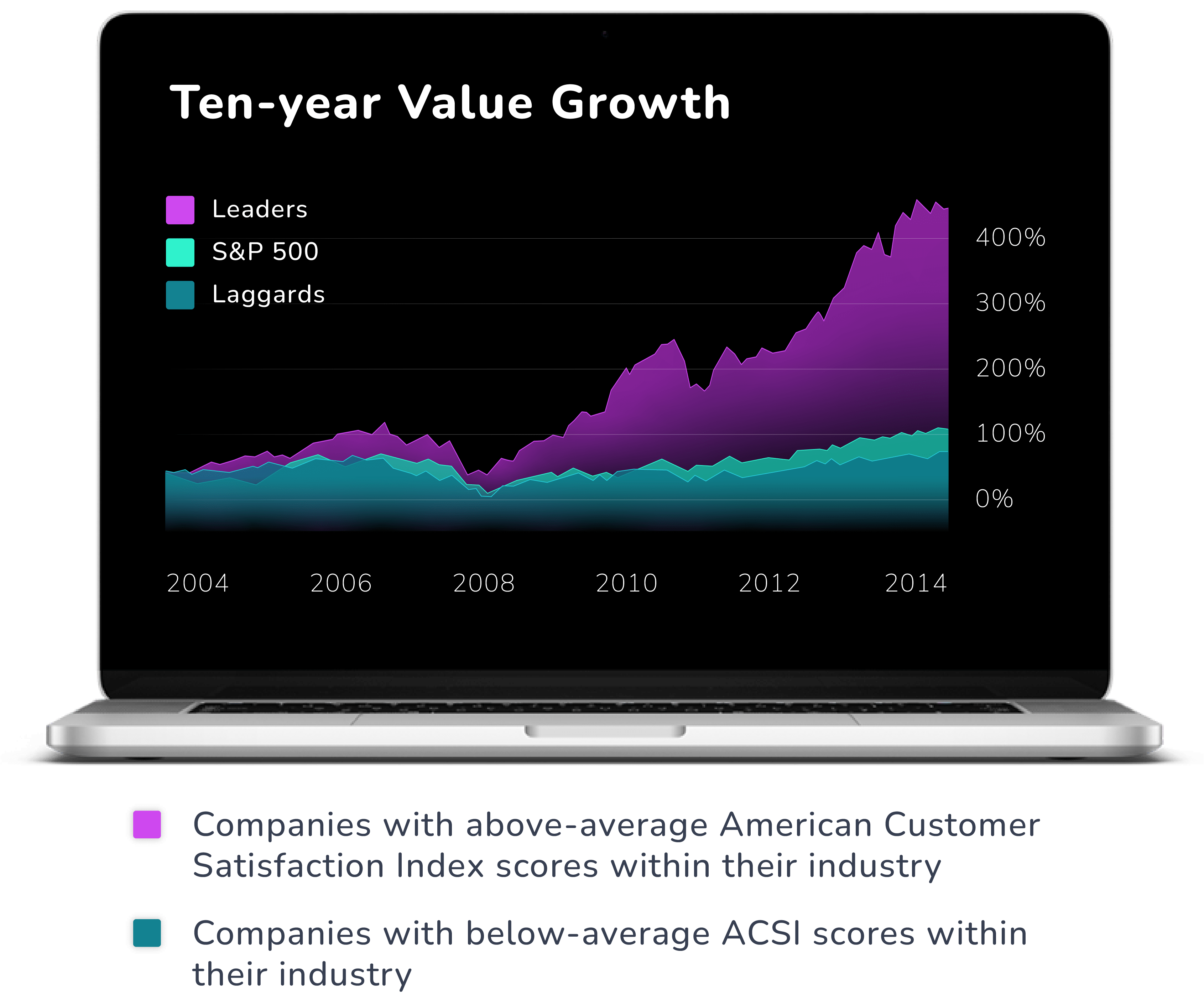
In this compelling article, McKinsey & Company explain how companies with above-average customer satisfaction scores yield four times the growth in value compared to average performers over a ten-year period.
The image below shows data from the American Customer Satisfaction Index and the Medallia Institute (Image 1).
Image 1: Ten-year value growth for companies with above and below average customer satisfaction scores.
From this context, we derive the following problem statement:
How might we optimize a digital product or service to connect business goals and customer goals in a way that achieves maximum customer satisfaction, given that there are numerous functional and psychological factors to consider throughout the user journey?
How to Maximize ROI For Your Digital Product
There are three primary ways to optimize your product and performance; a UX audit, usability testing, or a full redesign that follows the proper Design Thinking process.
UX Audit
A User Experience audit (UX audit), also referred to as a UX review or UX design audit, is a holistic audit of your customer experience. Though you will sometimes come across a dedicated UX team within a UX design agency that can conduct a UX audit for you, often it is a specialist who focuses specifically on this niche.
Specialists must conduct usability testing for many years to gain the practical working knowledge required to assess an interface and say with confidence which changes will yield real results. A true specialist will also recommend tracking desktop and mobile analytics after implementing changes to further refine and optimize performance.
A UX audit is delivered visually in the shape of a UX audit report and provides actionable recommendations on how to optimize your site structure, user interface, interaction design, and other extremely important parts of your experience.
Usability Testing
Usability testing (or user testing) is a form of observational user research that involves a series of one-on-one user interviews, where either some of your actual users or otherwise target users from your target audience are asked to complete tasks and talk about what they’re thinking and feeling as they move through various user flows. The researcher will compile findings into thematic groupings with actionable recommendations that are implemented and retested according to your company's business goals
If possible, it is always most beneficial to start with a UX audit, which can surface most of your issues quickly. Once these changes have been made, usability testing is perfect for ongoing optimization, refining the smallest details across even the most unique user groups and needs.
Product Redesign
This is the most expensive option but is sometimes the best way to go if your product is misaligned strategically in the market or suffers core structural or performance issues that can only be resolved by rebuilding.
Sometimes your digital product can just be outdated and no longer relevant. Websites that look outdated or don’t match industry standards are often seen as untrustworthy and will suffer from poor performance naturally.
Following the proper Design Thinking process will ensure you build something that has product-market fit. In the Design Thinking process, we start with stakeholder interviews to unpack known pain-points in the existing digital product, as well as to set business objectives, both of which help to determine the best research methods to employ.
Empathise - The first phase of the Design Thinking process seeks to empathise with your current users (or target users in the case of a new product). We do this through UX research, employing methods such as user interviews, user surveys or usability testing. It is also very helpful to conduct a competitive analysis or UX review at this stage.
Define - Having understood your users and their pain points, we can define the problem space by building user personas. These become the centre piece of your process, establishing customer centricity up front. Working from findings in the research, we then write problem statements that define the problem space for your user personas. From here we build out the information architecture and user flows for your product, which roll up into your overall user's journey.
Ideate - Problem statements are then solved through creative ideation, where multiple concepts are explored, merged and evolved into the optimal solution that fits the defined user flows.
Prototype - In this phase, ideas are wireframed into tangible, low-fidelity interfaces that can be combined into a working prototype.
Test & Iterate - The prototype is then used in a round of usability testing to determine how well the product performs at matching user needs with business objectives. All factors of the user experience are considered in this step, from usability to content, interaction design and many more. Learnings are assimilated and the product is iterated in this low-fidelity phase until it delivers optimal performance for both users and the business.
After that, it's on to defining the visual aesthetic and rolling out high-fidelity interface design, before going into development with confidence that we are making the best use of resources.
What Goes Into a UX Audit?
A UX audit report will include screenshots and annotations highlighting UX and design issues in your product. Issues are grouped by theme and explained through supporting design principles, relevant cognitive biases, and UX laws. Theory and practical knowledge are woven together within your unique context, considering general usability heuristics as well as specific UX & usability issues.
UX audits consider established patterns of human behavior and offer practical recommendations that can be implemented quickly and effectively. Key issues are solved with wireframed or redesigned suggestions, providing clear direction for resolution.
UX Audit Checklist
A good UX audit will evaluate your product comprehensively, and seeks to answer the following questions:
How might your product better help you achieve your business goals?
How might the product be designed to better meet your customers’ needs?
How might your product be designed to make it easier for customers to use?
How might your product keep users engaged through the purchase cycle?
How might your product build trust & loyalty with your users?
We answer these questions by first interrogating your business model and approach, assessing the synchronicity between business objectives and user needs. We then assess both content and functionality against broad rules (such as usability heuristics) and best practices, followed by a deep-dive into specific UX and usability issues.
Finally, we consider design for behavior change and the psychology of design as it affects your customers during the discovery and decision-making process.
Here is a list of specific factors that we cover in the UX audit process, among other things:
#1: Overall Usability
Is your product intuitive and easy to use? Usability directly impacts how successful users will be when using your product.
#2: Information Architecture
Is your content well organized? Good IA ensures customers can find what they need when they need it.
#3: Conversion Flows
Do your conversion paths keep customers engaged? These flows directly impact your bottom line.
#4: Psychology for Design
Do you know how people think? Cognitive biases and design principles affect your UX and impact engagement.
#5: Visual Design
Is your design letting you down? Visual aesthetics have a proven impact on people’s emotions.
#6: Communication & Language
Is your content easy to understand? Good communication provides the right context at the right time.
#7: Accessibility
Is your product accessible to most people? Effective design caters for different ages, eyesights, disabilities, environments & more.
#8: Interaction Design
Are your feedback mechanisms impactive? Interactions guide and move users through pathways.
Why Should You Get a UX Audit?
In our experience, UX audits provide the most value for money, plain and simple. At SalientUX, we combine Design Thinking lead product design experience with over a decade of experience in conducting usability tests in nearly every industry.
This means we have a tried and tested knowledge of what works and what doesn’t, supported by theory, examples, and validated design patterns and principles. A UX audit covers all aspects of your experience up front and gives you a high-impact, prioritized set of actions that you can begin implementing immediately.
User experience audits are an excellent way to lift your design and performance by quickly identifying key issues & providing powerful recommendations.
You can learn more about our user experience audit report here, or send us a message and we’ll book a free consultation to discuss your product and its potential.
Who Are UX Audits For?
Any digital product that has potential for improved performance, be it a company website, application, desktop software, or ecommerce website, will benefit from a UX audit. Here are a few common examples:
Business Owners, Digital Product Owners, or Marketing Leads that are looking to improve product performance without wasting money on prolonged user testing or expensive ongoing agency fees.
CTOs or Development Leads who have a digital product but don’t want to spend tens of thousands of dollars hiring a Product (UX & UI) Designer. A UX audit helps to build a prioritized backlog of design improvements that you can take action on immediately. You get access to a deeply specialized skillset that you likely won’t get in a first hire, without the ongoing cost of employment.
Startups or small businesses who are hiring their first Product Designer, without any senior design skills in the business. We often see businesses investing in early hires that cannot define a strategically prioritized backlog of work that will make a real impact on the product. In these cases, a UX audit not only benchmarks your product for your designer, but also provides them with clear, senior direction on how to prioritize and implement effective changes.
Established utility-based products such as: Customer relationship or process management systems, desktop, medical or engineering software, FinTech solutions, or any Software as a Service (SaaS). For businesses like these, a UX audit helps to streamline even the smallest touchpoints in the experience.
Here, optimization of task flows and functionality reduces time and effort to complete tasks, user error, and development hours spent on bugs and other issues. Real percentage improvements in processing time and performance significantly impact your bottom line, especially as they compound over time.
For those who run eCommerce or sales-oriented websites, optimizing the conversion funnel with enhanced usability, behavioral motivators, and improved pain point management can have a profound impact on getting more customers through the purchase process, reducing drop-off, and improving engagement and customer retention.
How Much Does a UX Audit Cost?
We offer two tiers of UX audit: A full UX audit, which is best suited to established websites or utility-based digital products, and a website design review, which offers a comprehensive assessment of your performance and is ideal for new or smaller businesses that are looking to grow or yield higher returns.
Employing a full-time UX or Product Designer can cost you upwards of $90,000 a year, while ongoing agency fees can easily amount to much more than that.
Our entry-level website design review costs $2,995 and takes about 2 weeks to complete. If you have a larger or more established utility-based product, our full UX audit costs $9,975 and takes about 4 weeks.
Each UX audit is unique and delivered as an engaging visual report during a 90min playback and Q&A session. We’ve helped many businesses just like yours achieve 15+% improvement in performance. What would a change like that mean for your business over a year? How about 5-10 years?
If you’re still unsure whether a UX audit is right for you, don’t worry! We have an open-door policy and are always available to talk about your product and see if it would benefit from a successful UX audit. We only work with products that have real potential and will assess upfront whether or not our service is the right fit for your needs.
If you’re looking for a benchmark or to understand where your key areas for improvement are, you can request our free mini UX audit, which provides an overview of performance and experience issues.
